Micro operations are one of the major components that makes up the architecture of a computer. They are classified into 4 major types:-
- Register transfer micro-operations: These type of micro operations are used to transfer from one register to another binary information.
- Arithmetic micro-operations : These micro-operations are used to perform on numeric data stored in the registers some arithmetic operations.
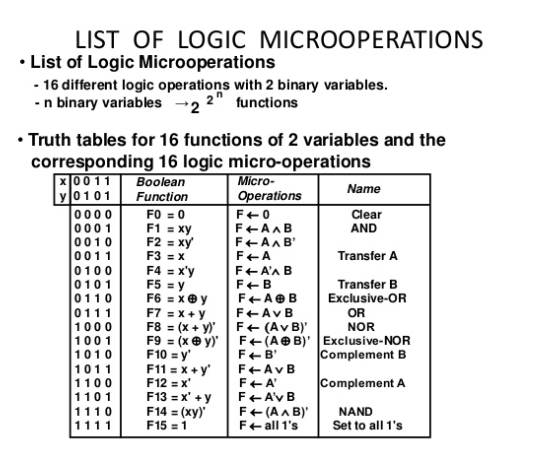
- Logic micro-operations: These micro operations are used to perform bit style operations / manipulations on non numeric data.
- Shift micro operations: As their name suggests they are used to perform shift operations in data store in registers.
Let us consider the first type: Register Transfer Microoperations:-
Microoperations can be expressed in terms of a Register Transfer Language (RTL). Trying to describe the design in words is pure folly.
A register transfer language is a type of Hardware Description Language.
For each clock cycle, zero or more microoperations occur in the CPU. There is no limit to how many microoperations can occur at once, provided that no two microoperations require the same circuit to do different things. Hence, hardware design is somewhat like parallel programming.
Now let us look into Arithmetic.
| Example | Description |
|---|---|
| R3 ← R1 + R2 | Addition |
| R3 ← R1 – R2 (R1 + R2′ + 1) | Subtraction |
| R2 ← R2′ | Complement (really a logic operation) |
| R2 ← -R2 (R2′ + 1) | Negation |
| R1 ← R1 + 1 | Increment |
| R1 ← R1 – 1 | Decrement |
Logic is the next one to look at
Shift Microoperations are used for serial transfer of data, they are also used in conjunction with arithmetic, logic and other data processing operations. The contents of a register can be shifted to the left or right. At the same time as that the bits are shifted the first flip-flop recieves its serial information from the serial input
There are 3 types:-
- Logical Shift
- Circular Shift
- Arithmetic Shift

 Computer Architecture